
Energy Platform · In-Home Display
Beyond the meter.
Intelligence at the edge.
Our agent turns standard SMETS2 hardware into a real-time energy management platform. The IHD runs a full interface on its built-in display. The CAD is screenless, managed through the mobile app. Same agent, same data, same tariff-aware scheduling.
Built on the Presciense Agent
Our agent is
what makes this work.
The agent is the software platform that sits on the device. It runs the Zigbee HAN to the Comms Hub, manages the 10-second ESME feed, and bridges broadband backhaul to cloud tariff and analytics services.
Without it, an IHD is a basic device that shows meter reads. With it, the same hardware becomes a real-time energy management platform that schedules appliances against live tariffs and coordinates every paired smart device.
The cloud layer resolves tariff schedules (including all 48 daily Agile half-hours), runs cross-device scheduling and consumption pattern analysis, and drives a GDPR-compliant analytics pipeline.
Agent Data Pipeline
The agent handles Zigbee SEP, DLMS/COSEM, GBCS, Modbus, OCPP 1.6/2.0.1 and local LAN protocols at the edge. Cloud telemetry runs over MQTTs. Device management uses USP (TR-369). Data normalisation happens at the edge before anything reaches the cloud or the display.
Dual-Path Architecture
HAN metering meets
cloud tariff data.
Legacy IHDs are limited to what the Comms Hub pushes over the Zigbee HAN. The agent adds a second data path over household broadband. It receives 10-second electricity consumption updates from the ESME via the HAN while simultaneously pulling dynamic tariff data and Agile half-hourly pricing from the cloud.
Self-install in minutes with a four-step setup wizard. No engineer visit, no supplier intervention. The agent configures the household energy profile, connects to home broadband and establishes the Zigbee 2.4GHz link to the SMETS2 Comms Hub automatically.
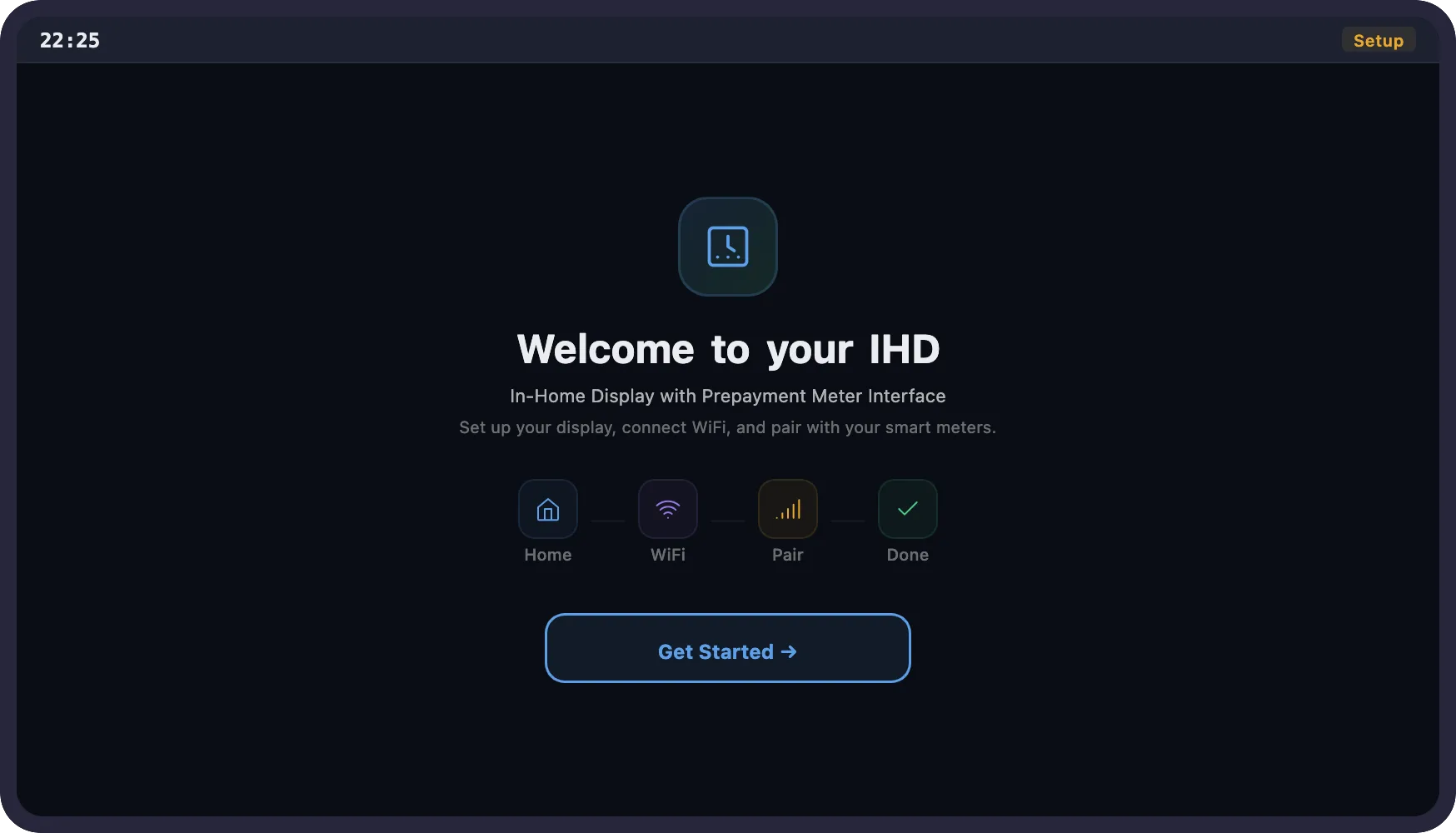
Four-step guided onboarding: property profile, broadband connection, Zigbee HAN pairing to the SMETS2 Comms Hub.
Live cadence
Electricity samples from the ESME over the Zigbee HAN.
Agile half-hours
Dynamic tariff data refreshed across the full trading day.
HAN + Cloud
Local metering and cloud tariff feeds fused into one live view.
Energy Data
10-second data resolution.
48-rate Agile pricing. One screen.
The dashboard combines real-time HAN metering data with dynamic tariff rates and consumption-pattern recommendations. What energy costs right now, what the household has saved, and what to do next.
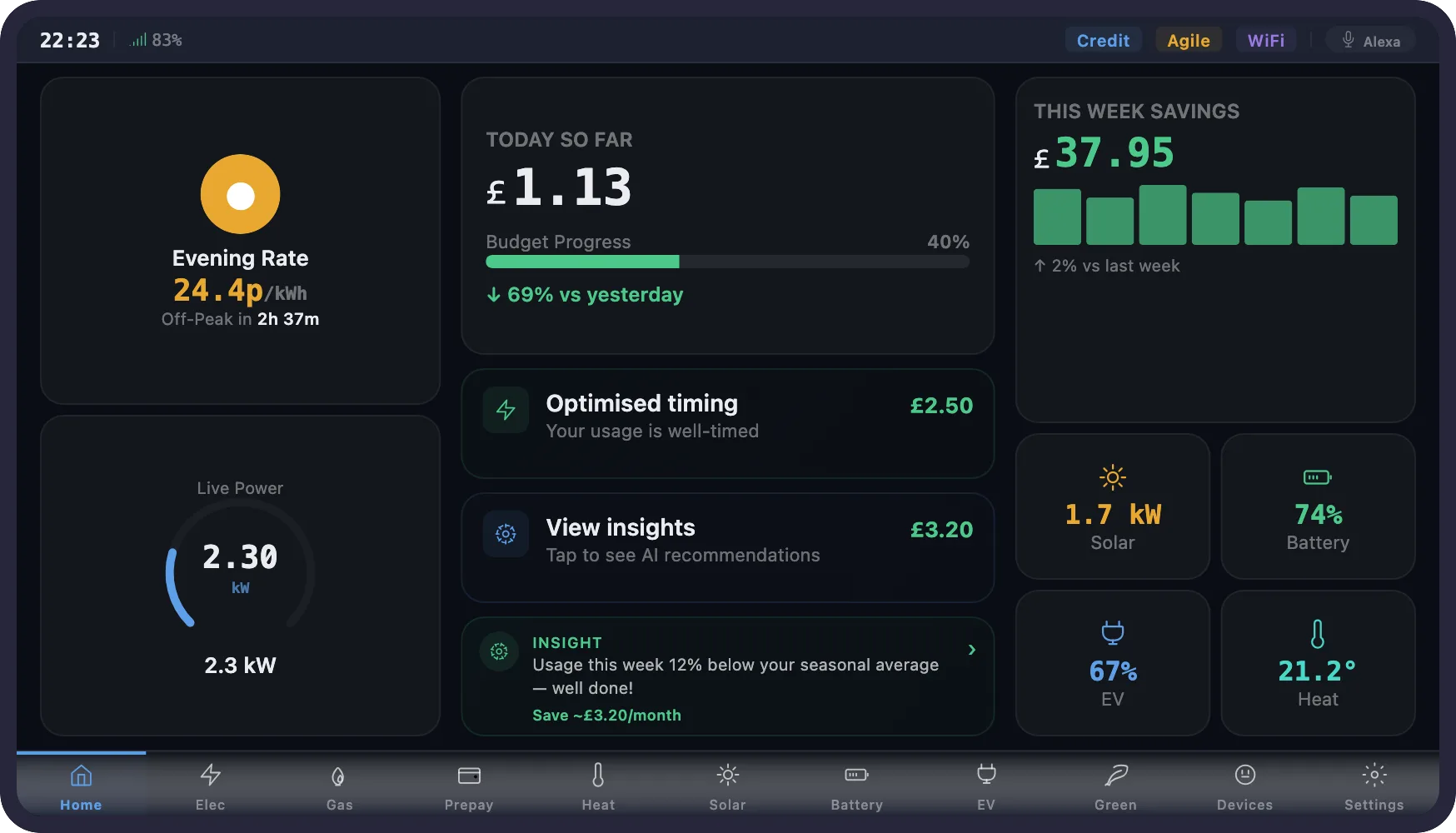
Main dashboard: live power gauge updated every 10 seconds, active tariff rate with off-peak countdown, daily budget tracking, weekly savings and status tiles for every paired smart device.
Electricity
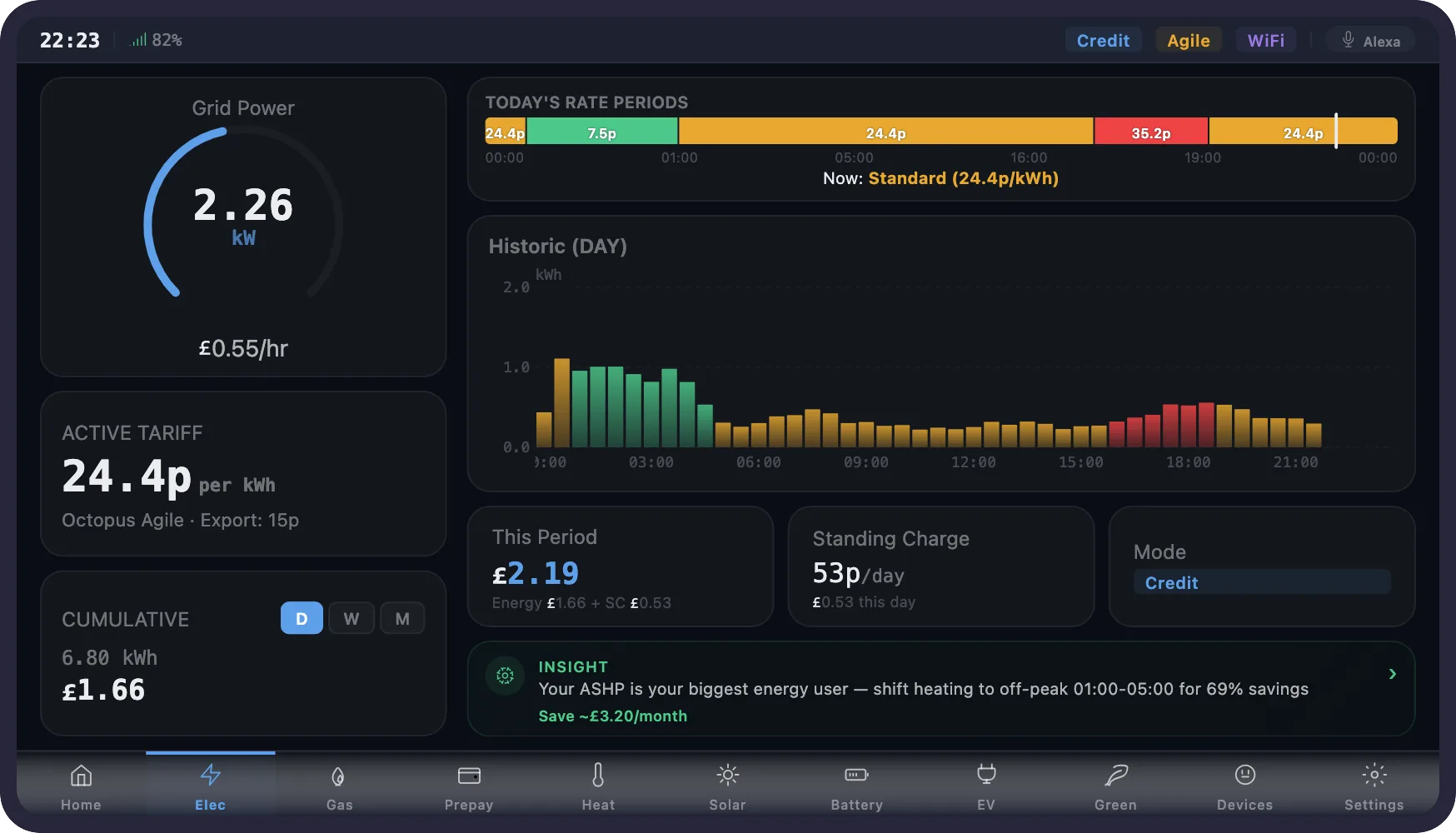
The electricity screen shows the full day's 48 half-hourly Agile prices colour-coded from green through amber to red. Standard SMETS2 TOU registers support only a handful of static rate bands. This device visualises all 48 distinct daily prices, giving customers the information they need for genuine load-shifting.
The historic bar chart colours each half-hour by the rate that was active, so it is immediately clear whether yesterday's load-shifting actually reduced costs. Cumulative consumption matches the reads that go to the DCC for settlement under Ofgem's Market-wide Half-Hourly Settlement programme.
Supports Agile, Tracker, Go and all future flexible tariffs. Not limited to static TOU bands.
Live Cost Accumulation
Today's spend is calculated by multiplying each 10-second sample against the active rate. That is far more granular than the meter's own daily billing read.
Transparent Billing
The cost breakdown separates volumetric energy charges from the standing charge, matching Ofgem's push for consumer transparency.
Pattern-Based Recommendations
Action cards analyse household consumption patterns against the forward tariff curve and connected device schedules, surfacing concrete savings opportunities.
Smart Home Scheduling
Solar, battery, EV, heat pump.
One tariff-aware scheduling engine.
Each connected device communicates via its own protocol (Zigbee, local LAN or cloud API) with the agent acting as the aggregation point. The scheduling engine coordinates all devices against the Agile tariff curve so they are not competing for the same cheap half-hours.
Solar · Live
Self-consumption first, surplus to battery, export to SEG.
Battery · Spread
Charge at the cheapest half-hour, discharge at peak. Health tracked.
Heat pump · Efficiency
Pre-heat at 7.5p, coast through the 35.2p peak. ~£500/yr saved.
EV · Charge window
Find the cheapest slots to hit target charge by departure time.
Solar Generation
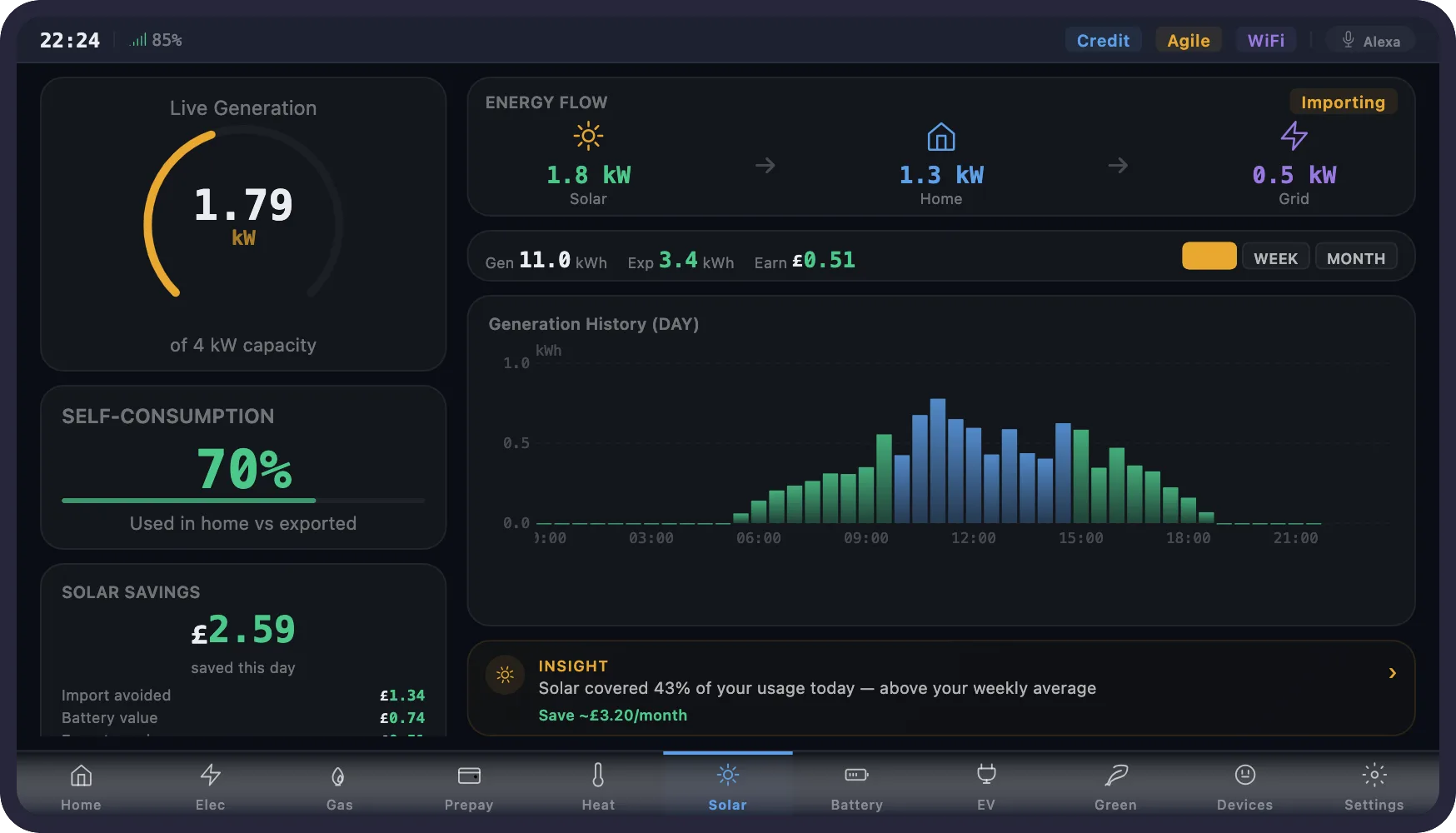
Live generation gauge with an energy flow diagram showing real-time power routing: solar to home, surplus to grid, excess to battery. The savings attribution breaks every kWh into three parts: import avoided, battery arbitrage value and SEG export earnings.
Export readings are captured from the ESME's export register for full SEG compliance and transparency.
Battery Storage
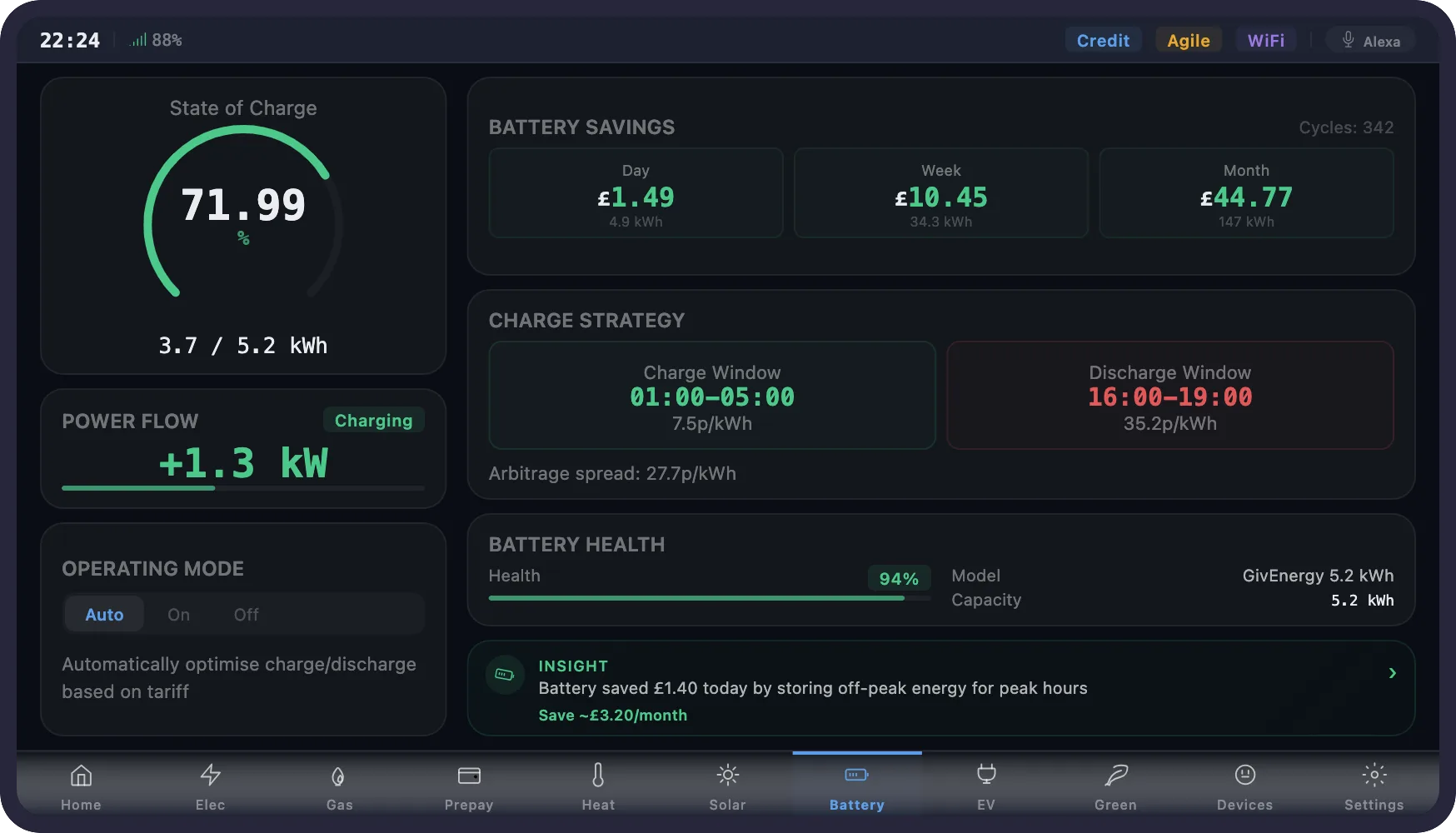
The charge strategy adapts daily to the Agile forecast, targeting the cheapest half-hours for charging and the most expensive for discharging. The arbitrage spread is shown transparently. At 27.7p/kWh on a 5.2 kWh battery, each full cycle earns roughly £1.44.
Battery health monitoring with degradation tracking gives early warning to claim warranty service before performance drops.
Heat Pump & EV Charging
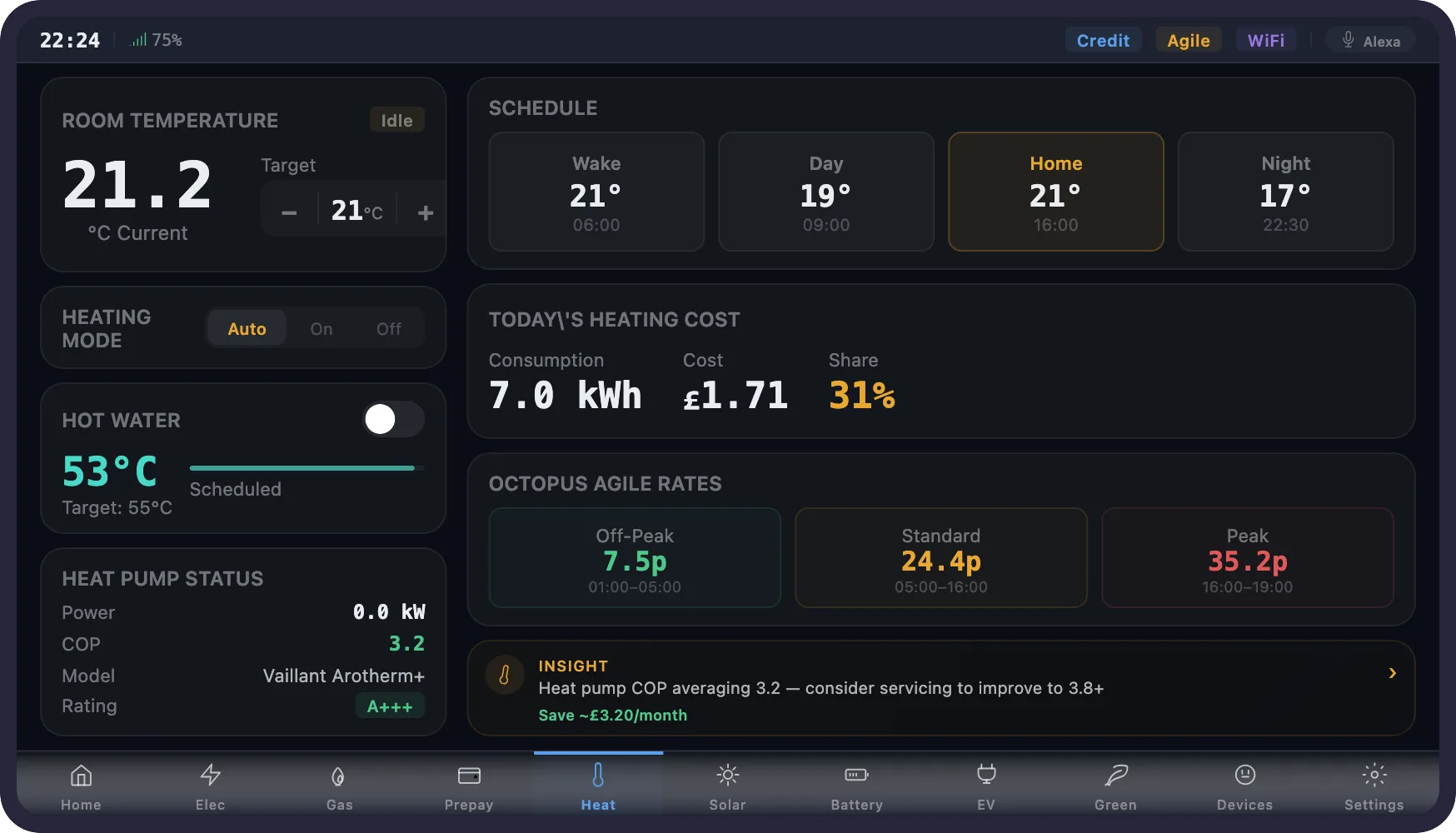
Heating is typically 40 to 60% of a household's energy bill. The IHD provides COP monitoring with degradation tracking, tariff-aware scheduling and real-time cost visibility. For Agile customers, pre-heating during the 7.5p overnight window rather than running at the 35.2p peak could save over £500 per year on heating alone.
EV scheduling works the same way: examine the forward Agile curve, find the cheapest half-hours to reach the target charge level by departure time, and coordinate with the battery and heat pump so they are not all drawing at once.
Carbon & Grid Awareness
Grid carbon intensity.
Household green score.
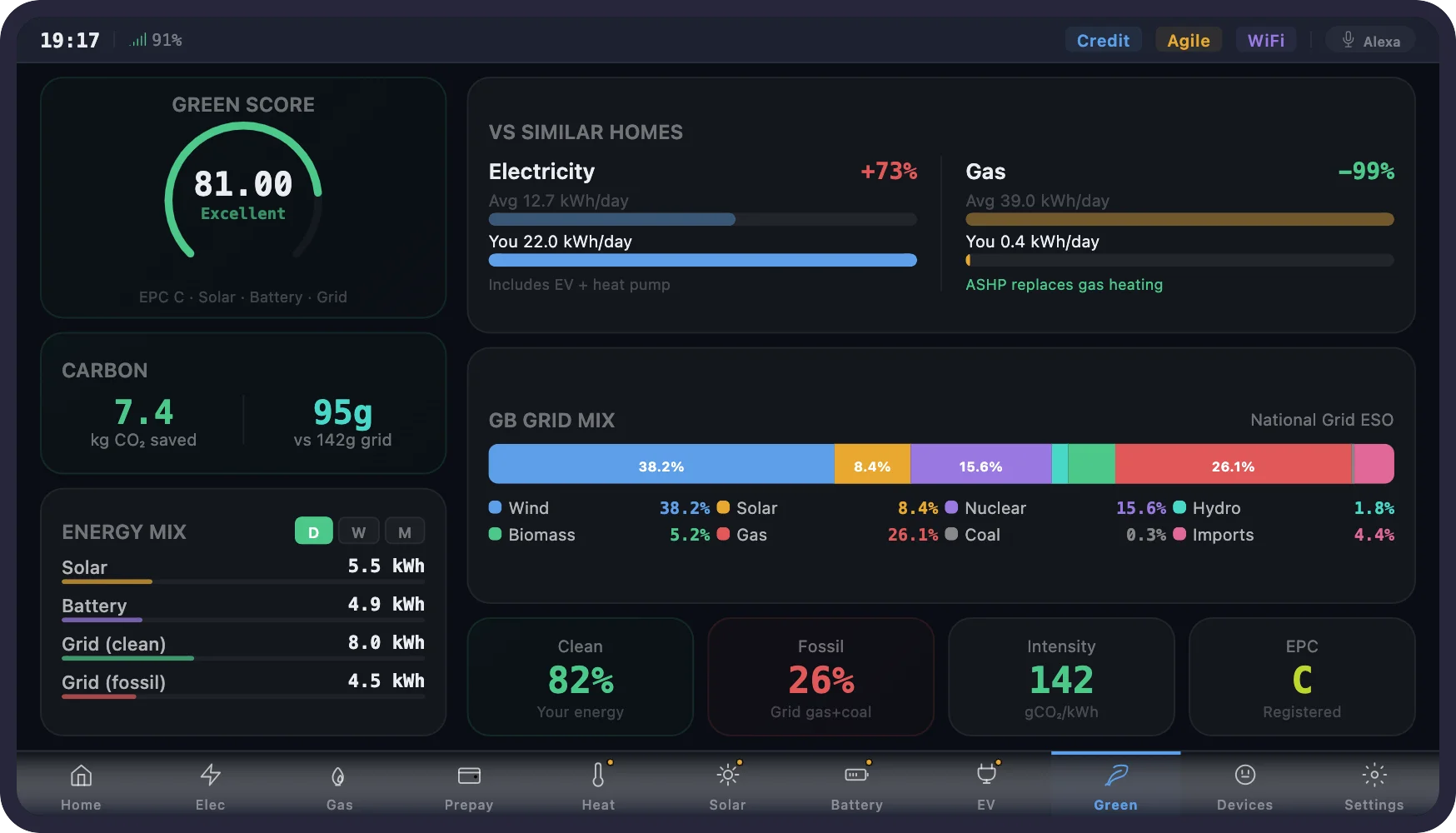
Carbon intensity data is sourced from the national grid's generation mix. When wind and solar dominate, intensity drops. When gas peaking plants fire up, it rises. The agent tracks this in real time and connects it to the household's consumption, so customers can see that shifting to off-peak is usually cheaper and, thanks to overnight wind, often greener too.
The green score (81/100 in this example) is calculated from the household's energy mix, self-consumption rate, carbon savings versus similar homes and EPC rating. The GB Grid Mix panel shows the live breakdown: wind, solar, nuclear, gas, biomass, coal, hydro and imports, with clean vs fossil percentages.
The "vs similar homes" comparison puts consumption in context. This household uses 73% more electricity than average (explained by the EV and heat pump) but 99% less gas because the ASHP replaces gas heating. That is the kind of context that makes the numbers meaningful rather than abstract.
Supports Ofgem's net zero objectives by giving consumers real-time visibility of grid carbon intensity alongside their own consumption data.
PPMID Compliance
Full prepayment support.
No compromise.
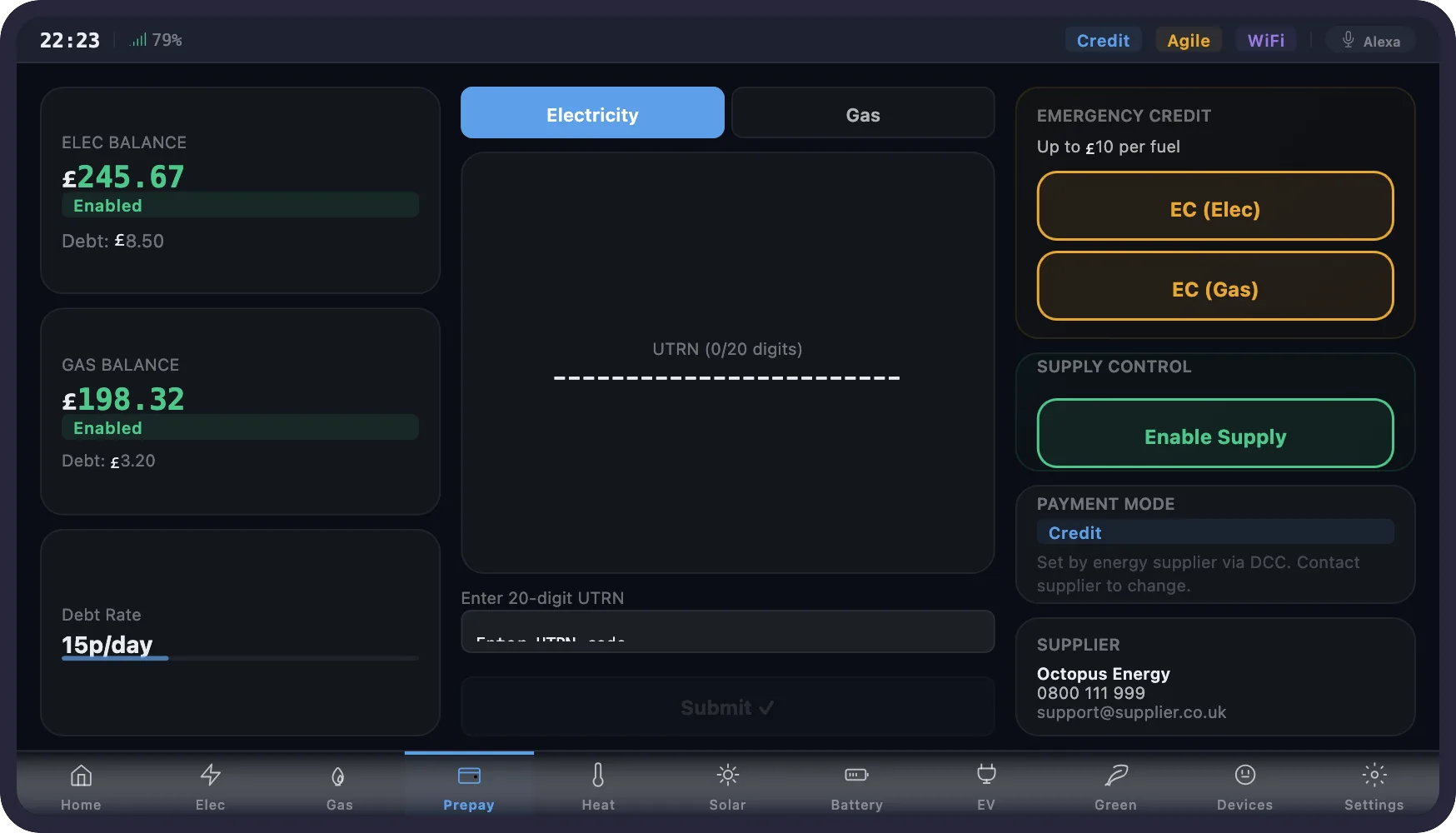
The agent implements the full SMETS2 PPMID technical specification in dual-mode. Dual fuel balances read directly from the ESME and GSME prepayment registers via the Comms Hub HAN. UTRN entry with visual digit confirmation sends the 20-digit code through the DCC to the supplier's head-end system for validation and credit application.
Emergency credit activation, debt tracking with daily recovery rate display, and supply reconnection control. Complete prepayment management without needing a separate device, phone or shop visit.
Prepay customers get the same energy data, tariff scheduling and device integration as credit customers, on both the IHD and the CAD via the mobile app. To our knowledge, no other IHD or CAD on the market combines PPMID functionality with smart home scheduling.
Mobile App
The CAD interface.
And remote IHD access.
The mobile app serves two roles. For CAD customers, it is the primary interface: the only way to set up, configure and use the screenless CAD hardware. For IHD customers, it provides remote access to the same data when away from the wall-mounted display. Either way, the app delivers the same 10-second electricity updates, half-hourly Agile pricing and smart device telemetry. Not a stale daily summary. Live data at the same resolution as the IHD.
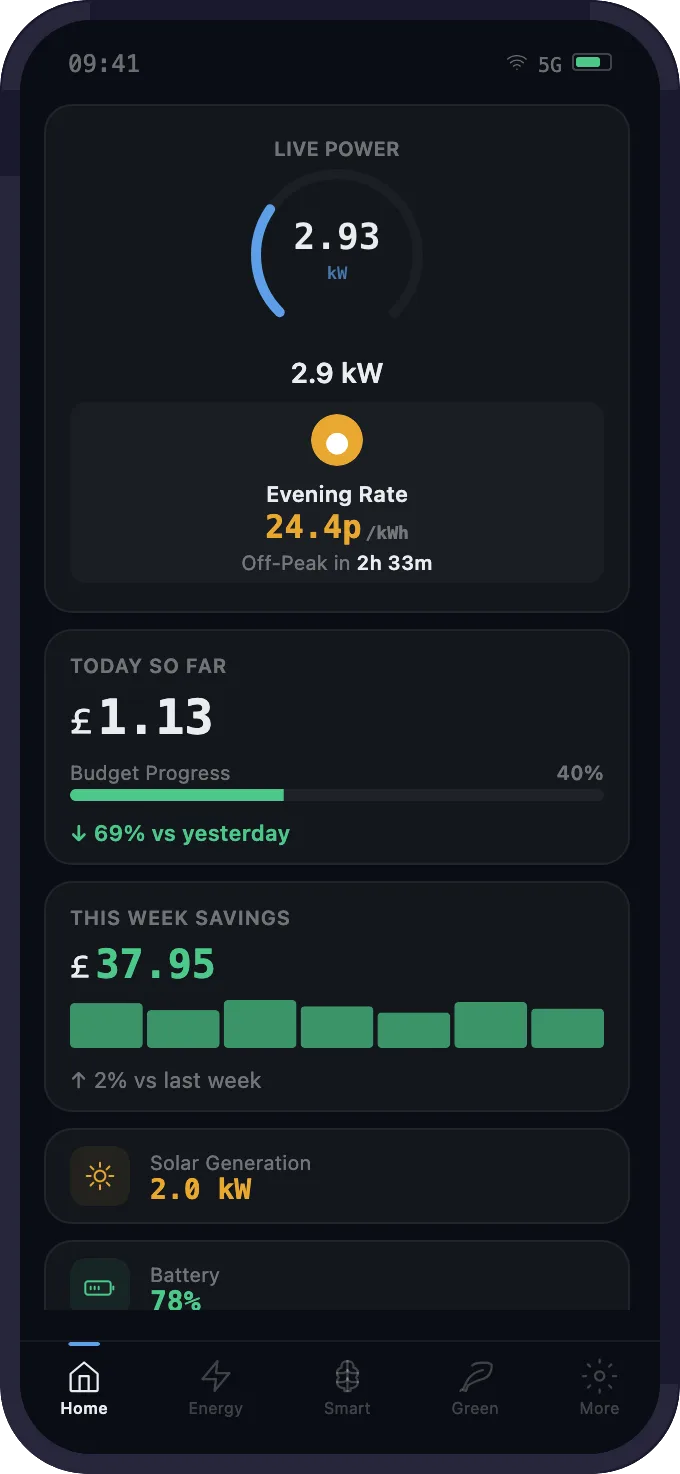
Home dashboard with live 10-second consumption, budget progress and device status
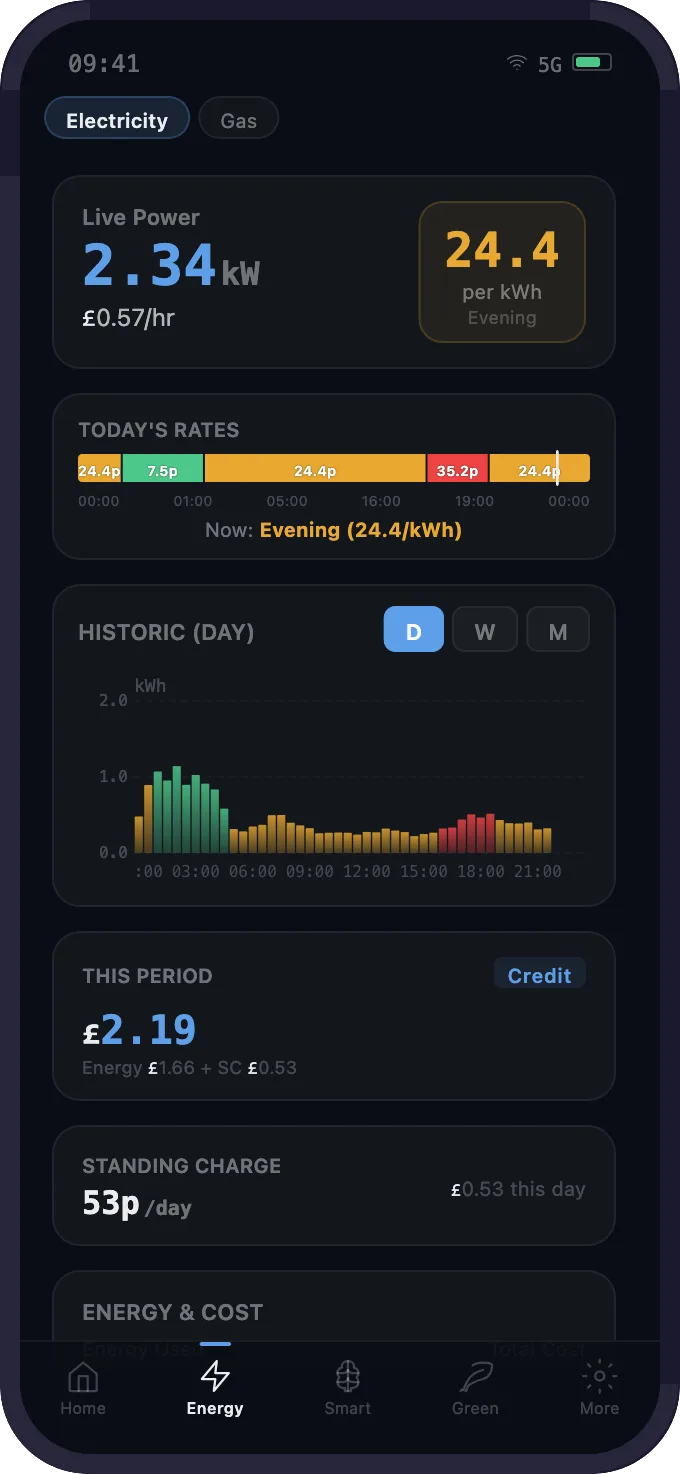
Electricity detail with 48-rate Agile timeline and rate-coloured historic chart
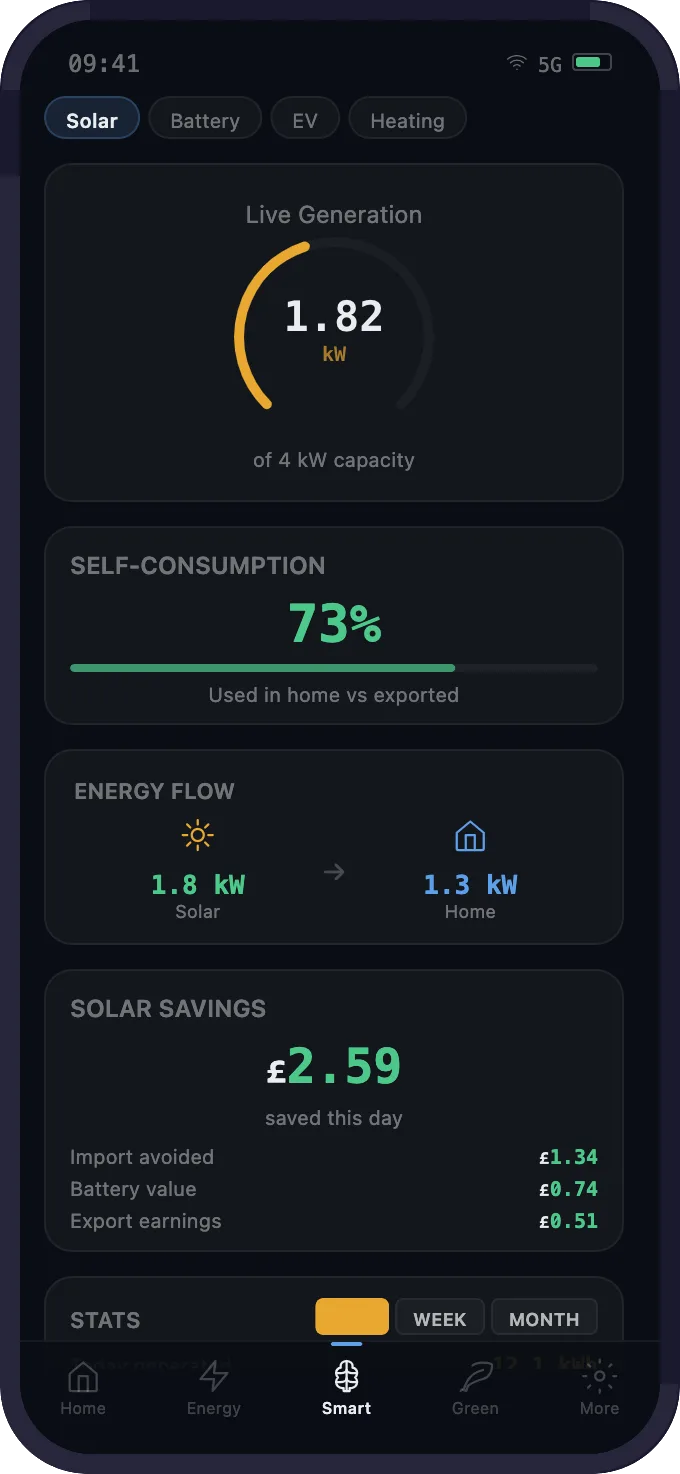
Solar generation with energy flow, self-consumption and three-part savings breakdown
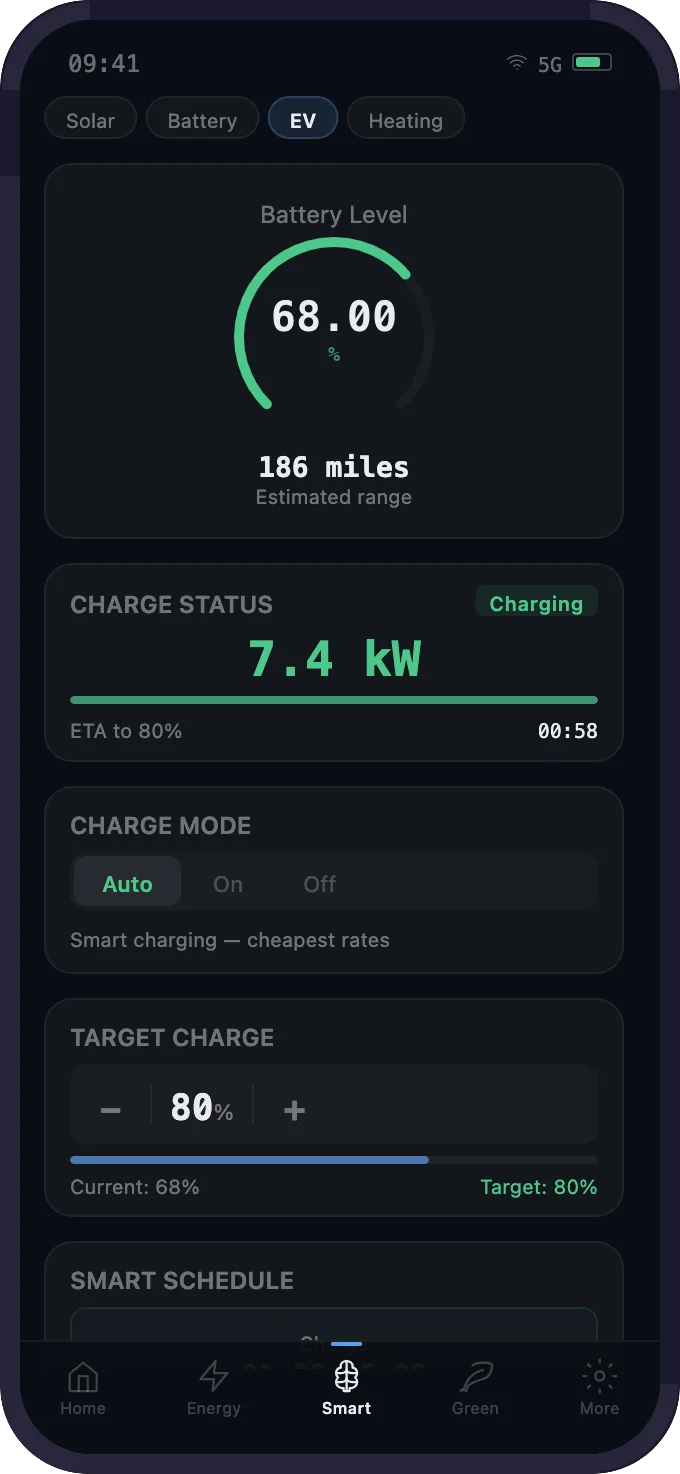
EV charging with live status, smart scheduling to cheapest Agile rates and target charge level
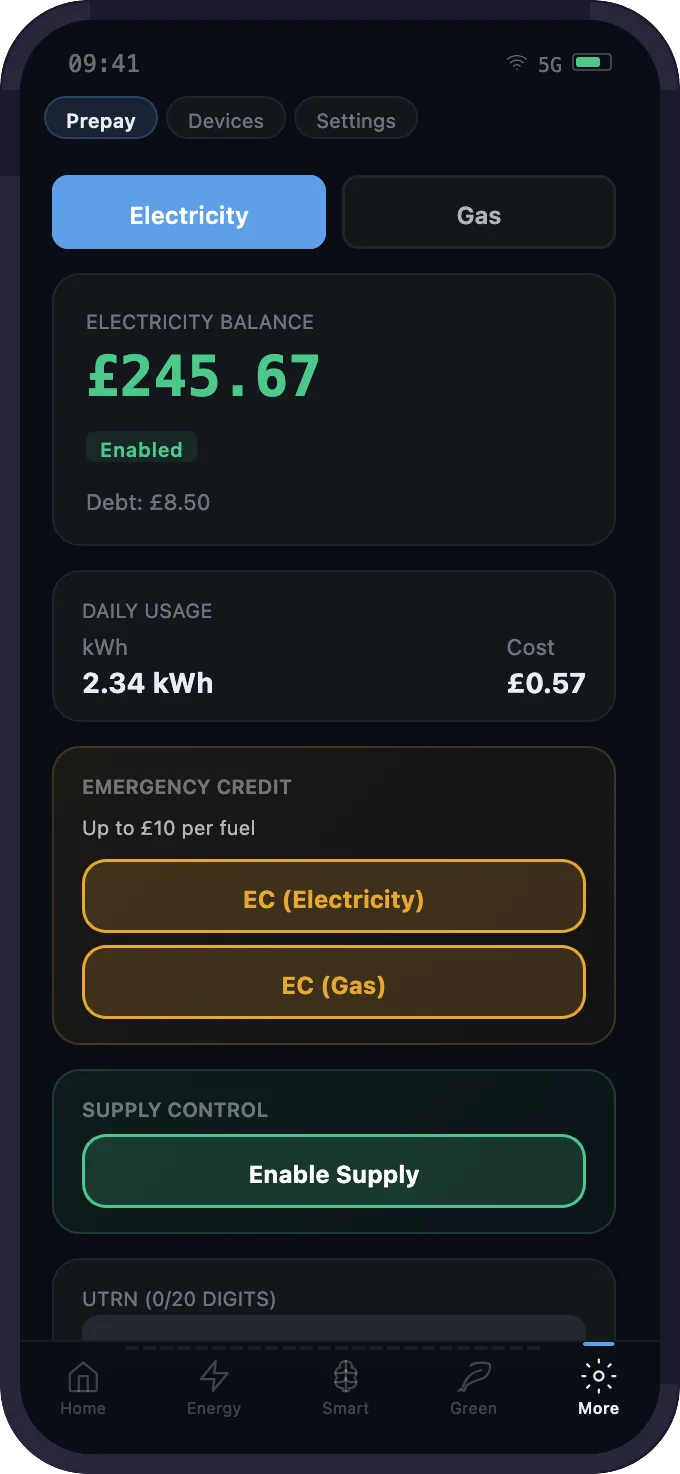
Prepayment top-up the moment a UTRN arrives, even away from home
Platform & Diagnostics
Protocol-agnostic integration.
SEC-compliant diagnostics.
Device Management
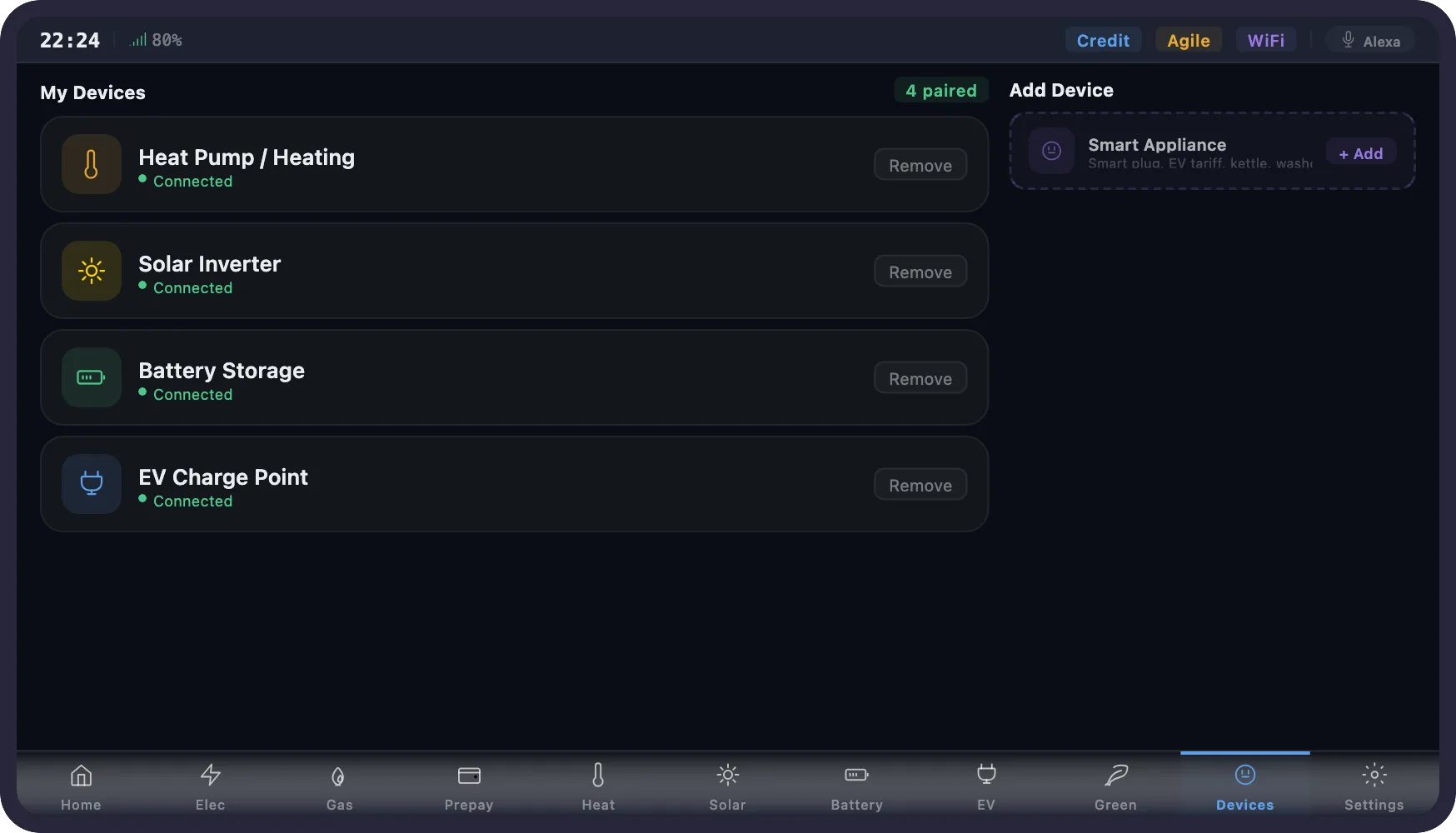
Every connected device (heat pump, solar inverter, battery storage, EV charger) is listed with connection status, protocol details and signal quality. The agent handles the integration: Zigbee SEP for HAN devices, Modbus TCP/RTU for solar inverters, OCPP 1.6/2.0.1 for EV chargers, cloud API for heat pump integrations. The customer sees one coherent view regardless of the underlying protocol.
For installers, the device screen provides quick verification that a newly paired device is communicating correctly.
Diagnostics & Compliance
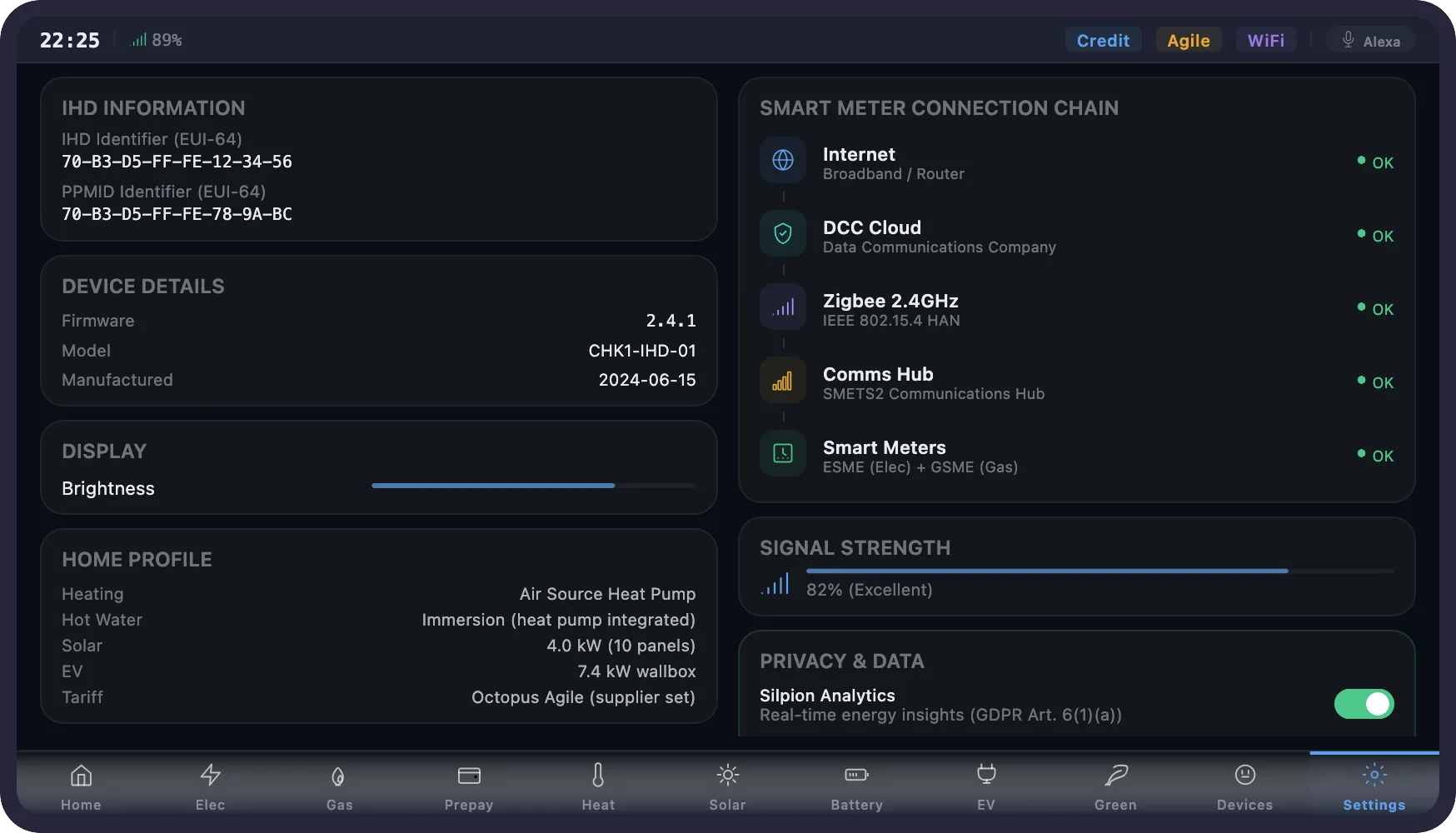
The five-stage connection chain maps every link in the SMETS2 data path: Internet, DCC Cloud, Zigbee 2.4GHz (IEEE 802.15.4 HAN), SMETS2 Comms Hub and Smart Meters (ESME + GSME), each with a live status indicator. We are not aware of another consumer device that exposes this level of diagnostic detail.
The GDPR analytics toggle references Art. 6(1)(a) directly, making the lawful basis for cloud-based energy analytics visible to the customer from either device.
Cuts support call time significantly. Customers can report exactly which link in the chain has failed, supporting remote triage before dispatching a field engineer.
Standards & Data Models
The agent is built on open standards throughout. Metering data, device protocols, cloud telemetry and remote management all use published specifications rather than proprietary interfaces.
Also from Presciense
Device Management Platform
Commission, manage and secure VWAN device fleets at scale. Portal for operators, field app for engineers, same security boundary.
Explore Device ManagementWork With Us
Ship a smart meter product that does more.
If you're an energy supplier, network operator or technology partner, let's talk about how the IHD and CAD platform fits your roadmap.